
Can You View Arizona Arrest Records?
In most cases, yes. Arizona public arrest records rest on a broad premise: any government record an officer holds is open to inspection unless a law or a strong public interest justifies keeping it back. That right belongs to the record, wherever it sits. Still, nothing forces a sheriff, police department, or jail to run a searchable online arrest feed. Many simply do not. So a request to the office that made or keeps the record is often the practical route. Keep in mind what each document tells you. An arrest report captures an event, a jail entry shows a booking, and a docket tracks the case. Charges can shift or vanish as the process moves.
Arizona's Open Records Standard
A.R.S. § 39-121 puts the core rule in plain terms. Public records in an officer's custody stay open to inspection during regular office hours. Redactions, confidentiality rules, and fees can still shape what you receive. A record can exist even when no web search finds it, because no office is required to publish a searchable roster online.
Arizona's law also runs on a balancing test rather than automatic release. In its 2026 Goldwater Institute v. City of Phoenix opinion, the Arizona Supreme Court laid out the test. An agency resisting disclosure must point to specific, material harm, show that harm is likely, and tie it directly to release. Vague worries do not count. Statutory privacy protections and investigative privileges survive the test.
Silence carries a cost too. When a public body fails to respond promptly, the statute treats access as denied. That opens the door to remedies, including a withholding index where one exists, the legal basis for keeping material back, and release of whatever can survive redaction. A good first request simply asks for the record and the specific rule or harm the agency relies on.
Note: A record's online absence does not prove that an agency lacks a responsive file or that the event did not occur.
Request Arizona Arrest Records
A narrow request travels faster than a blanket demand. The arresting police agency keeps the incident report. The county detention agency holds the booking sheet, and the court keeps the docket. Name the record and the event you want.
- Choose the likely custodian. Use the arresting agency for its report, the county jail for booking or custody fields, and the court for a case record.
- Describe the event with the person's name, arresting agency, place, approximate date, and a report or booking number if known. Include a date of birth only when needed to tell apart people with similar names.
- Ask for specific existing items, such as the booking sheet, booking and release fields, charges as booked, bond information, or a booking photo if maintained and releasable.
- If part is withheld, ask for the remaining record with protected details redacted, the legal basis for each withholding, and a withholding index where available. Keep the request and the agency's response.
Commercial requests play by their own rules. Under A.R.S. § 39-121.03, the requester must state the commercial purpose accurately, and the law sets different fee rules and penalties for misuse. Forms, response times, and copy costs shift from agency to agency. One more caution applies: never ask an office to certify facts another office actually holds.
For an Arizona arrest made by state troopers, the AZDPS report-request route handles records the state agency created. Wondering where someone was booked or whether that person remains in custody? The county detention office is the next custodian to ask.
Where Arizona Arrest Records Appear
Match the source to the question. A county roster answers custody questions. An agency file records its own event. A court docket tracks case activity. Sometimes you will need more than one source to see the whole picture.
| Record layer | What it can show | What it cannot establish alone |
|---|---|---|
| County jail or sheriff roster | Current custody and available booking fields | A complete arrest history or final court outcome |
| Arresting police agency | Its own incident or arrest report | Another agency's live jail status |
| Arizona court docket | Filed charges, hearings, and case disposition | That a person was booked into a particular jail |
| State corrections search | Prison custody after a sentencing path | A same-day county arrest or jail booking |
No result does not mean no arrest. Ask the office that keeps the record. A missing roster entry could reflect release, a transfer, a delay, or a search outside the roster's date window. It settles nothing on its own.
What Arizona Agencies May Redact
A released record may arrive with pieces missing. One statute creates a special hurdle for certain law-enforcement or prosecution records that visually depict a minor witness or a victim. Under A.R.S. § 39-121.04, a requester filing a special action must show that public interest in disclosure outweighs the privacy interest at stake. The affected victim gets notice and a chance to be heard in the situations the law covers.
Juvenile records follow their own map. A.R.S. § 8-208 lists what may be inspected: certain referrals, arrest records once a juvenile is accused under a separate statute, and delinquency or disposition hearings. The same statute shields victim identity and lets a court keep information confidential when the public interest clearly demands it. Juvenile social and detention files are nothing like an adult booking list.
Redaction is not the same as closure. A victim's identity, a protected address, witness detail, medical information, or an investigative lead can come out while the rest of the file goes out intact. Ask for a redacted copy instead of assuming the whole record is sealed.
Note: Arizona's victim-privacy law can protect identifying details even when the rest of an arrest record is available for review.
Why Arizona Record Access Varies
Arizona has no single county booking interface or uniform photo policy. Pima County's sheriff stopped publishing booking photos online after litigation. The Arizona Public Media report explains the backdrop. That was a local choice, not a statewide ban. Other counties differ on what they display. Entries also stay up for different lengths of time. For a fuller picture, the statewide Arizona booking-photo overview maps which official source to check. A blank web page never proves a photo is absent from the government file.
Arizona's Mugshot Website Law
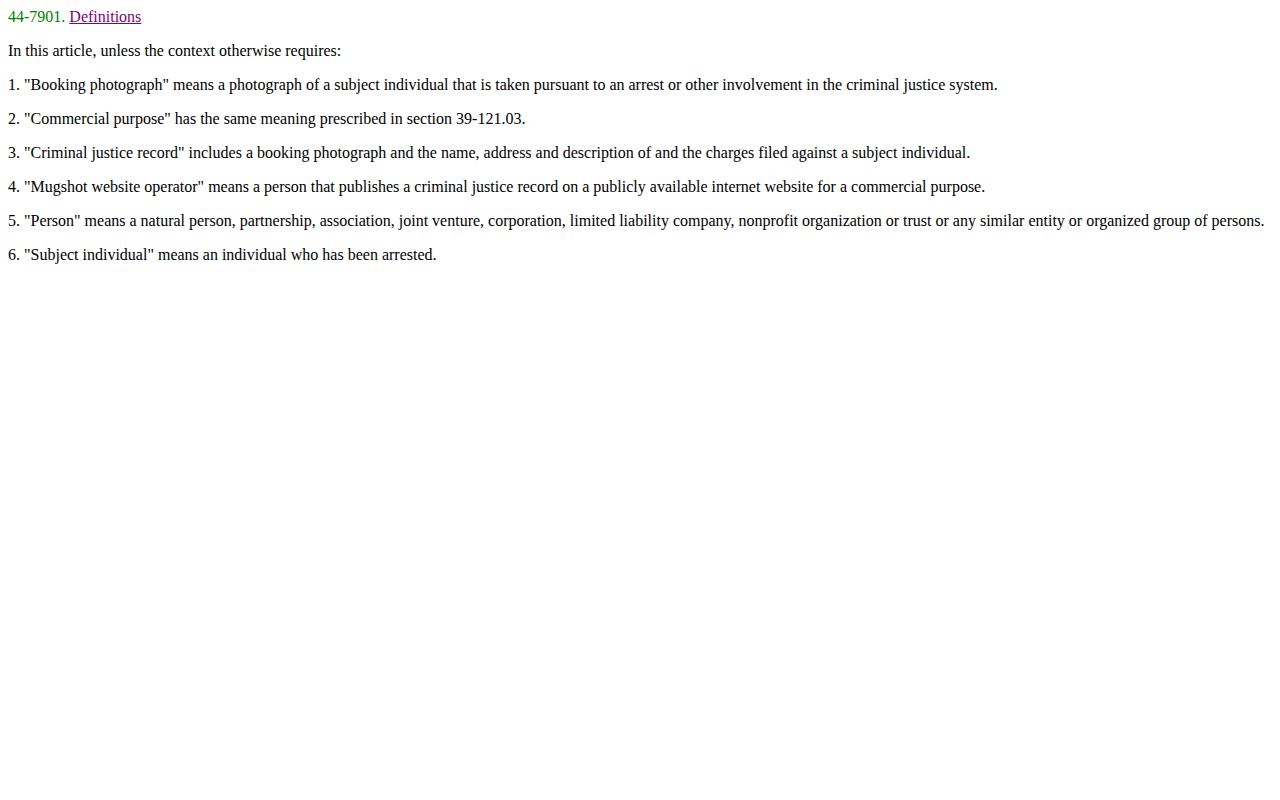
Arizona leaves sheriffs free on booking photos. No state rule forces them to post every mugshot or pull images after release. The Mugshot Website Operators Act aims elsewhere. It targets commercial operators who exploit a criminal justice record to demand money for removal or revision. A booking photo may pair with a name. Under A.R.S. § 44-7901, the record can also carry an address, physical description, and charges.
A.R.S. § 44-7902 goes further. A covered publisher counts as transacting business in Arizona. The law bars using a record or identifying details to solicit pecuniary gain, which includes money or anything of value offered to remove or revise a listing. Victims get a private action. Damages start at $100 per day for 30 days, then $200 per day for the next 30, and $500 per day after that, subject to the statute's elements. News-related dissemination is exempt. So are certain licensed professionals handling a current or expected proceeding.
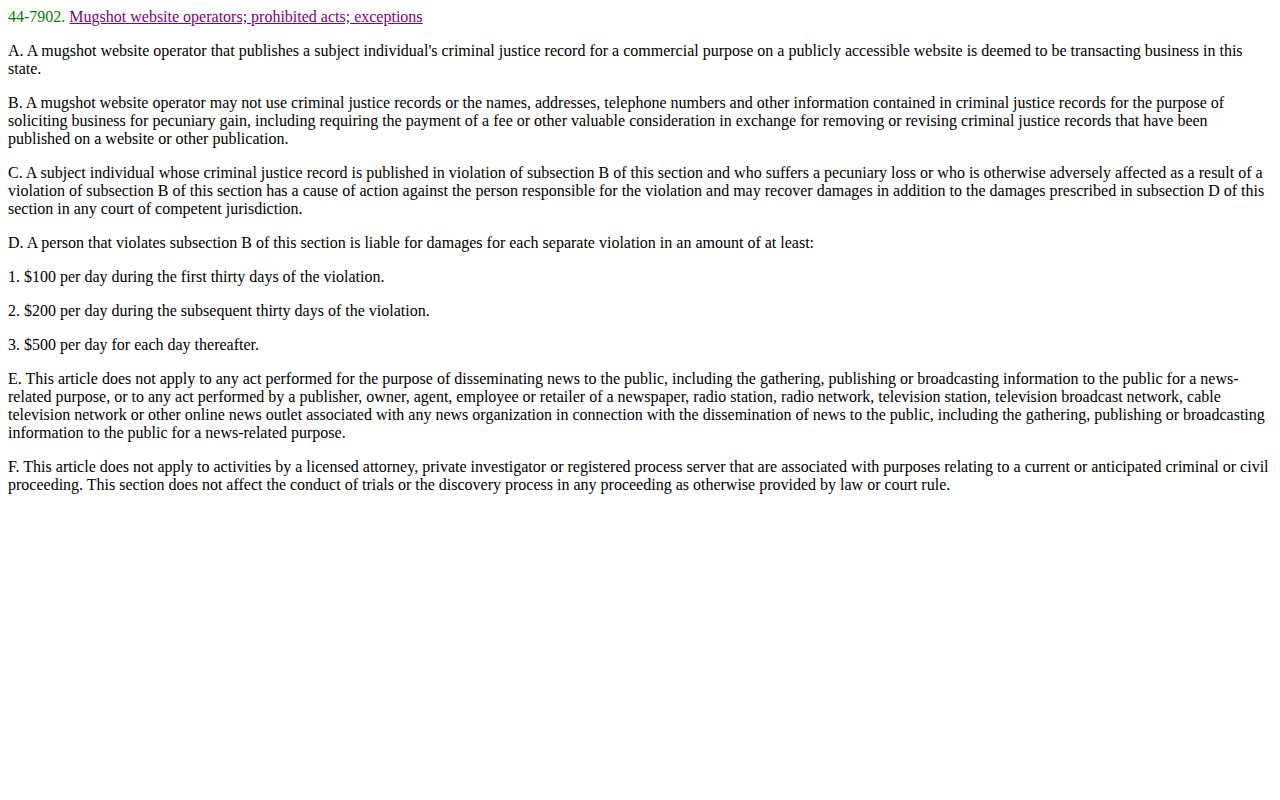
The target is paid removal solicitation, not accuracy. Nothing in the law forces a publisher to delete an accurate item just because someone asks.
Arizona Mugshot Law and Litigation
Arizona passed the Mugshot Website Operators Act in 2019. Its aim was commercial sites charging people to take down or soften a booking record. Laws 2019, Chapter 42 took effect August 27. It did not ban publication. Nor did it force agencies to delete arrest photos.
In 2024, the Ninth Circuit let a claim move forward in Houston v. Maricopa County. The pleadings plausibly described a punitive booking-photo display with no rational link to transparency. The ruling stopped there. It created no statewide takedown rule.
Related state litigation remains open. The Arizona Supreme Court docket for Houston v. Penzone lists a pending petition for review. That petition is not a final statewide ban.
Does Sealing Remove Arizona Records?
Arizona's main adult remedy is sealing. Expungement, by contrast, usually means a record is erased. Sealing limits public access to covered government records but leaves outside copies untouched. Under A.R.S. § 13-911, an eligible person may petition once the law's conditions are met. That can follow a completed sentence, a dismissal, a not-guilty result, or an arrest that never led to a charge. Offense-based waiting periods apply. So do serious exclusions.
The Arizona Courts sealing page walks through the process. The court weighs the petitioner's interests against public safety and other factors. An order limits public access to covered records, though courts, police, and prosecutors may still reach them for purposes the law allows.
Waiting periods start after sentence terms other than payment are complete. Fines, restitution, and other financial obligations must also be satisfied. The general periods are:
| Offense category | General waiting period |
|---|---|
| Class 2 or 3 felony | 10 years |
| Class 4, 5, or 6 felony | 5 years |
| Class 1 misdemeanor | 3 years |
| Class 2 or 3 misdemeanor | 2 years |
Some records never qualify. Exclusions cover dangerous offenses, dangerous crimes against children, serious or violent felonies, crimes involving a deadly weapon or serious injury, and sex trafficking. Petty offenses and some vacated convictions follow special rules. The Arizona Courts sealing page links the forms and filing details.
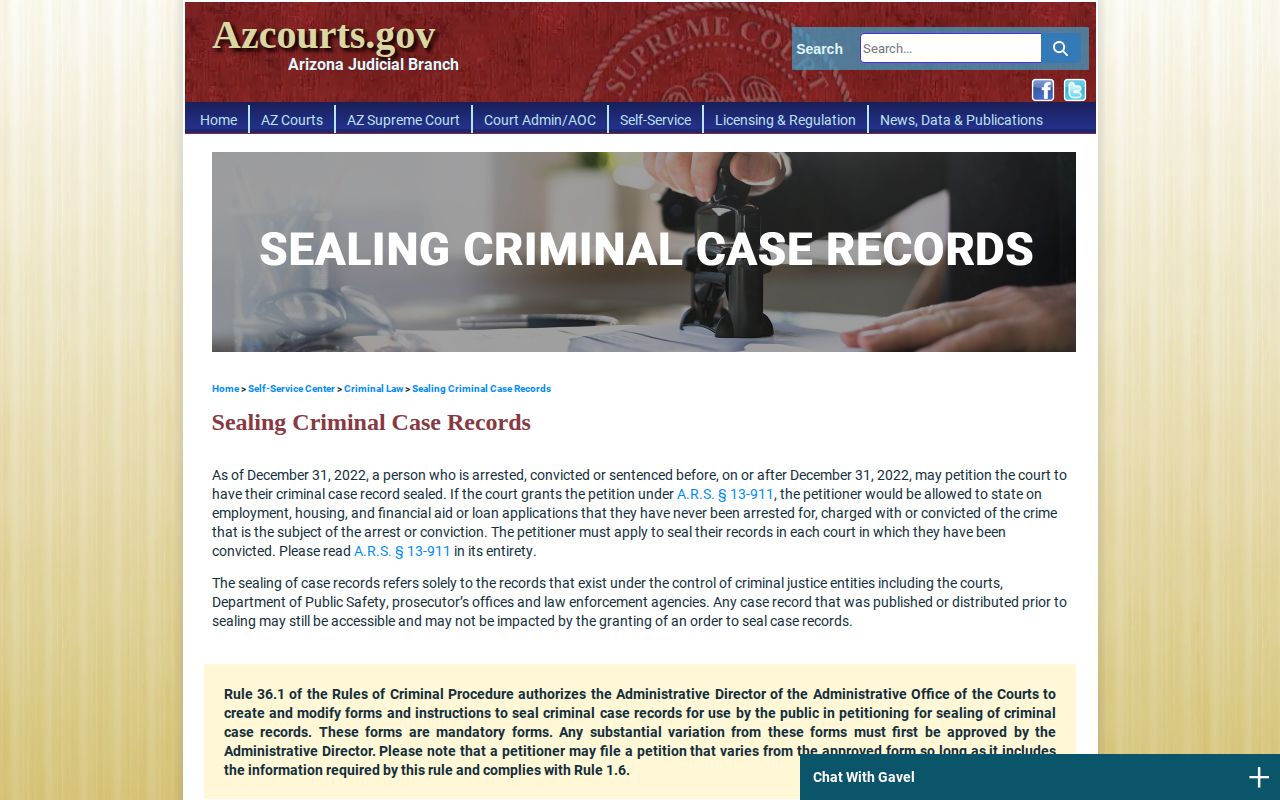
A sealing order reaches only the records within its scope; any outside copy needs its own correction request.
Free Corrections for Stale Copies
Start with whoever created the record. A wrong government entry? Send the agency the record URL or number plus the court document that backs the fix. Once the source is corrected or sealed, contact each publisher holding a copy. Ask for an update. A search engine only indexes pages. It controls neither the government file nor the publisher's archive.
| Route | What it can change | Limit |
|---|---|---|
| Agency or court correction | The official entry or case record, if the custodian confirms a factual or legal change | Contact the office that holds the record |
| Court sealing | Public access to eligible government case records after an order | Requires eligibility and a court decision |
| Publisher's free review | A publisher's copy when its policy accepts the reason and proof | Each publisher makes its own decision |
| Search-engine update | An outdated search title, snippet, or image after the live source changes | Does not erase the record or saved copies |
RecentlyBooked's stated policy invites free correction or removal requests for a dismissal, a seal, a wrong-person entry, or an outdated record, provided supporting information is included. That is the publisher's own choice. It is not an Arizona court order, and it promises nothing.
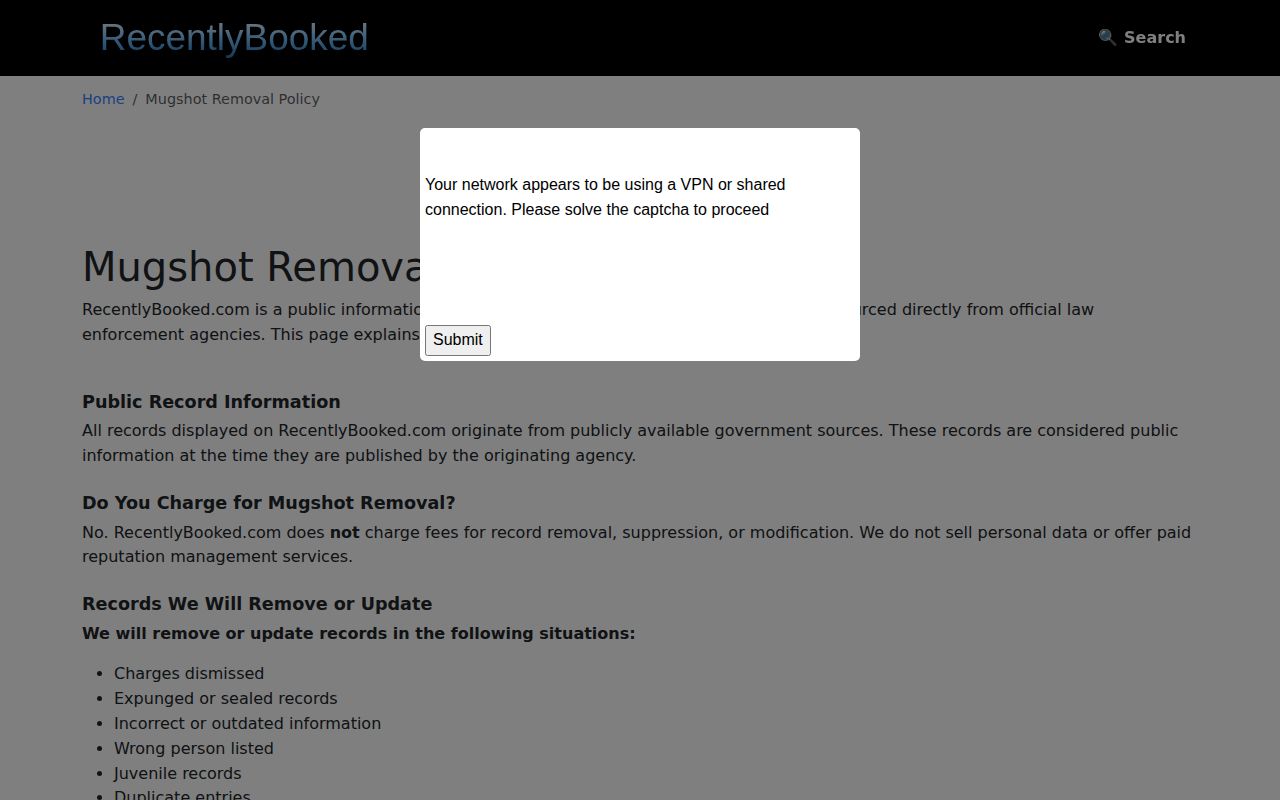
A publisher's policy is not a court order or a promise that a listing vanishes. Each publisher controls its own copy.
Never pay a demand to remove a listing. Arizona's statute carries limits and exceptions. No private request wipes out every copy of a lawful record. A specific dispute may deserve an Arizona lawyer's advice.
Once a live source changes, an outdated-content request can refresh its search title, snippet, or image. It cannot erase the record, the news archive, or a saved screenshot.
Arizona Arrest Records in Archives
Arizona stores its old arrest records under a formal retention system. The Arizona State Library's 2026 general records schedules spell out how long booking and detention records must survive. Two series matter here. Series 20836 covers certain booking records and photos filed alongside an incident report. Series 20837 keeps adult booking material for ten years after last contact. That applies when no departmental report holds it. Which schedule applies depends on filing choices and any legal hold. Retention rules answer only part of the question. A record can be retained yet never posted online. It might still sit on a live jail roster. Or a third party may have saved a booking photo long ago. If an agency comes up empty, ask which series and schedule governed the entry. Also ask for the last-contact date, and whether the record moved or was destroyed. For a search of older material, come prepared. Name the agency, the series, the rough date, and any case or report number. Ask if a digital copy exists. Ask what access limits apply, and how long a response takes.
Note: A search result, a roster, a court docket, and an archival file can each preserve a different part of the record.