
Arizona Recent Arrests
No single public database holds every Arizona booking. Each county chooses its own format. Some run current-custody lists, others rely on date searches, PDF files, selective releases, or nothing public at all. The arresting agency and the jail custodian can be two different offices. Highway Patrol arrests show this split often. A roster entry reflects that source's scope and update schedule, so it may not mark an arrest from that day. The person could have been cited and released, transferred, or gone before the list refreshed. Start by naming the likely agency and county. Then use that county's official detention or records route. The County Directory links each locality's site, and many county pages also point toward city police records.
From Arrest to County Booking
The Arizona Department of Public Safety includes the Highway Patrol Division. Troopers work from statewide districts and specialized units. Releases cover only selected arrests. AZDPS publishes no daily named arrest log or dispatch feed. A release may skip the county booking sheet, current custody, and any photo. Where does a trooper's arrestee land? Usually the county or local jail takes custody. But a citation with release, a transfer, federal custody, or immigration custody can reroute the person. The Attorney General outlines the county-jail and initial-appearance path. For a trooper report, ask AZDPS; for custody, ask the county; for case events, ask the court. The agency's district structure does not turn its releases into a jail roster. Its dedicated arrest guide also explains that distinction.
Arizona Arrest Feed Windows
No single statewide clock defines "recent." A current-custody roster can leave out people already released, while a date search may pull in names nobody still holds. Monthly logs read as history, and news stories pick and choose. Check the date and scope on each source before calling an entry same-day or multi-day.
The Daily Arrest Report maps same-day routes. The linked Weekly Arrest Log covers the multi-day picture. Neither label turns a current roster into proof of an arrest date.
Find Arizona Recent Arrests
Begin with the agency and the place. Then pick the record that answers your question, because a news item, a warrant hit, a custody screen, and a court case are four different things.
- Identify where the arrest took place and which agency made it. A highway stop may involve AZDPS, while the county or local custodian holds the jail booking.
- Open the official county roster or booking route and note its own date, status, and update language. A current-custody result may not show people already released.
- If the county has no online roster, check its official detention or records page for a phone or request route. Use a PDF or press release only for the dates and events it actually covers.
- Ask the custodian for a specific booking record or photo if the online view is missing or too brief. Name the likely date and exact record type so the office can search its files.
- For a single person’s custody alerts, use the participating VINE system; for charges and case outcome, check the court. A post-sentencing search belongs with ADCRR, not the county jail.
These records split into stages. One shows a fresh booking, another current custody, then release, a court result, and a later prison record. An empty search is never final; ask the custodian.
Search Arizona Jail Rosters
Arizona jail rosters share no standard search form. Yuma accepts booking-from and booking-to dates and adds a current-custody filter, while Pinal says its roster updates hourly and drops people after release without stating any booking lag. Other counties lean on names, status fields, PDF dates, or reports. A failed search can trace to spelling or timing. A transfer, a release, or agency coverage can also be the cause.
| Search field or control | Where documented | Use and limit |
|---|---|---|
| Name | Online county custody searches and VINELink | Try likely name forms and review identifying details; a similar name is not a match |
| Booking date range | Yuma County Inmate Search | Booking From/To supports a dated query; updates are periodic, not guaranteed in real time |
| Current-custody filter | Yuma and other county roster views | Defines a current list, not every person arrested or later released |
| Booking or agency ID | VINELink and some custodian records | Can narrow a match when available; Arizona has no shared statewide identifier field |
Apache County's Citizen RIMS displays current custody. Its separate arrests module is disabled, so skip any old vendor page or guessed link.
What an Arizona Booking Record Shows
A booking record documents a jail intake. It can carry charges, custody dates, release or transfer details, and a photo taken while the person was held. An online roster may show less. Public-records law does not force every field online, and the booking sheet itself is not the court disposition.
| Field or custody stage | What it may show |
|---|---|
| Name and booking identifier | The identity fields and control number used by the holding agency; a name alone may not resolve a match |
| Booking date and agency | When the jail processed the person and which arresting or booking agency is named |
| Charge as booked | The charge entered at intake; it may later change, be declined, or be dismissed |
| Bond or release fields | Terms or later custody movement when recorded and releasable by that custodian |
| Booking photograph | An image only where held and publicly released; Arizona counties follow different photo policies |
| Just booked or in custody | A roster may show current holding status; a fresh booking may not appear until the source updates |
| Released or transferred | The person may leave a current roster while the booking record stays with the agency that made it |
| Case filed or resolved | The court docket and disposition follow a different path from the jail’s intake record |
| State-prison record | ADCRR number, custody status or location, and release-related data after sentencing, not county intake |
Arizona's criminal-justice-record definition pairs a booking photo with identifying details and charges. No county must display them. An ADCRR state-prison profile appears later, after the court and sentencing path.
- Booking
- The intake process that records a person after an arrest or transfer into custody.
- Bond
- A court-set condition that may allow release while a case is pending.
- Arraignment
- An early court hearing where the person is told the filed charge and enters a plea.
- Disposition
- The court’s recorded outcome, such as dismissal, acquittal, plea, or judgment.
- Sealing
- A court order that limits public access to eligible government case records under Arizona law.
Arizona Mugshots and Photo Rules
Arizona has no blanket photo-publishing rule. The Maricopa County Sheriff's Office, MCSO, runs a public inmate and mugshot lookup. Litigation has tested that practice. In Houston v. Maricopa County, the Ninth Circuit revived a substantive-due-process claim at the pleading stage in 2024. That ruling set no statewide ban. It did not invalidate the mugshot law either. A petition remains pending at the Arizona Supreme Court. The official MCSO Inmate Information page is the live source for its current scope. Its lookup interface displays without publishing a person's photo.
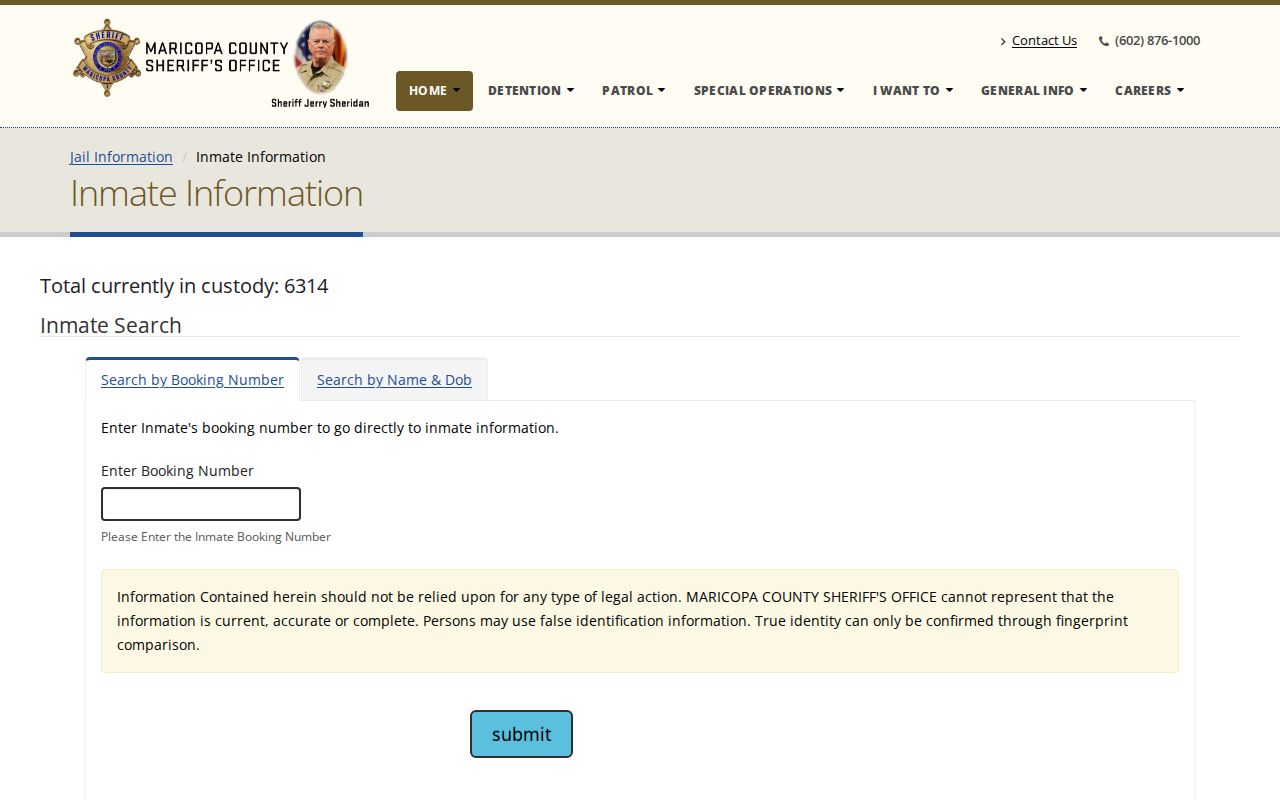
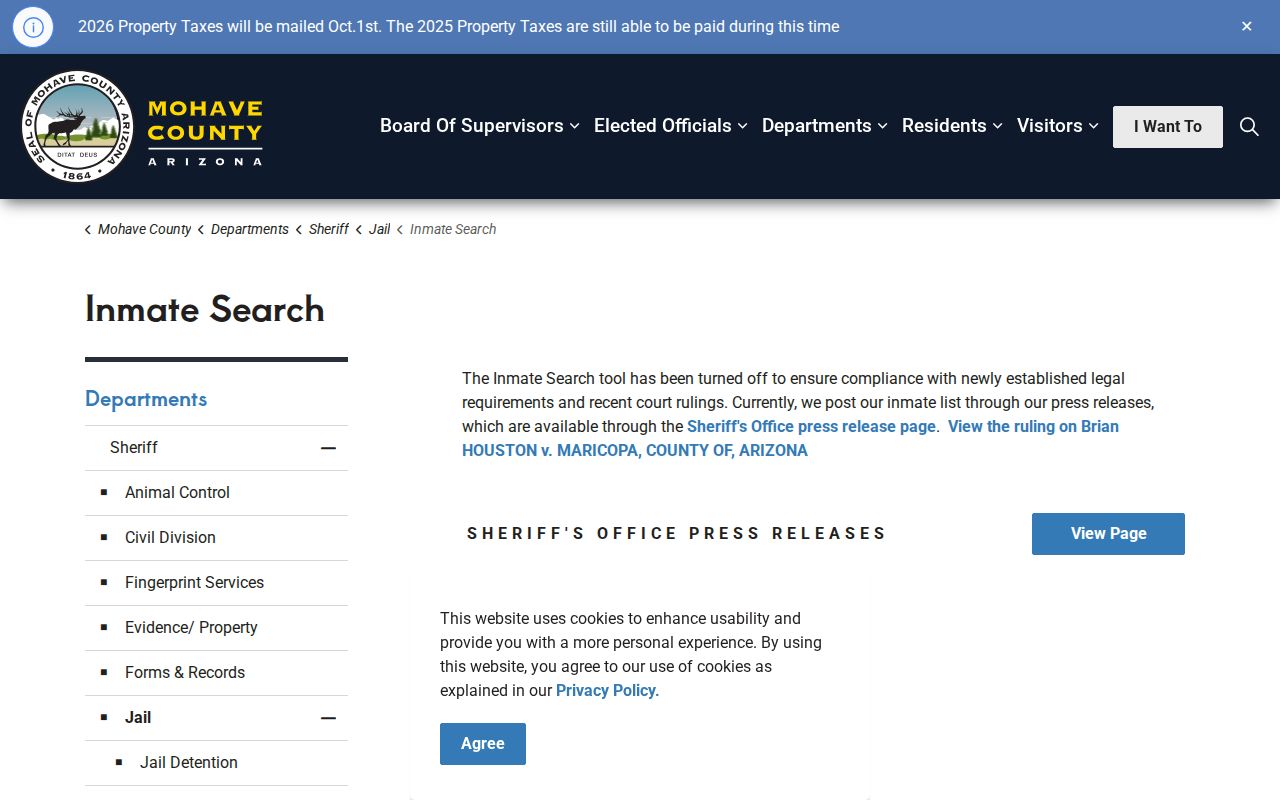
County policies split sharply here. Pima County Sheriff's Department stopped releasing booking photos in any format after the Houston litigation. Cochise pulled its public Mugshot and Inmate List tabs. It also quit adding booking photos to press or social material. Pinal's roster shows no public photo. Its separate mugshot search is offline. Mohave turned its inmate-search tool off, and its Sheriff points readers to selective press releases rather than a complete photo roster. The Pima County Inmate Lookup remains a current-custody route, not a booking-photo page.
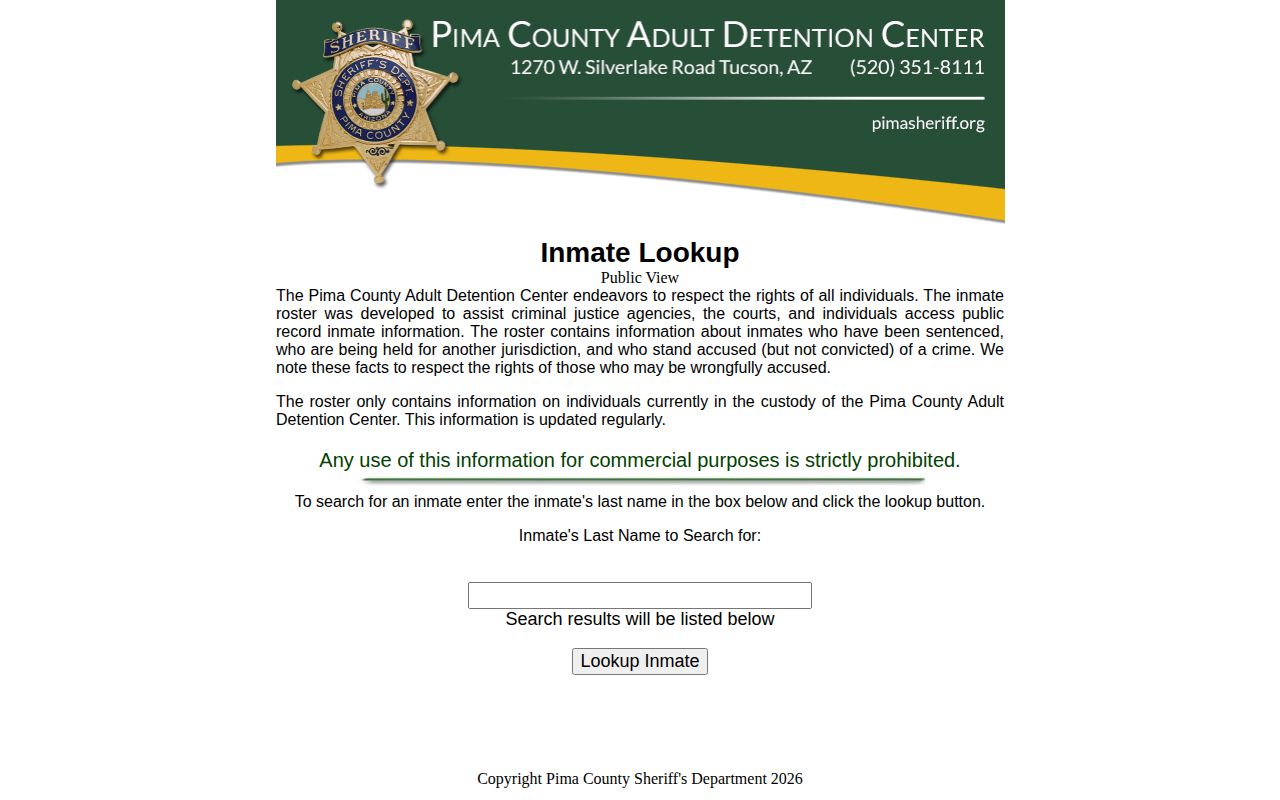
One photo rule cannot cover Maricopa, Pima, Cochise, Pinal, Apache, Yuma, and Yavapai. Each county configures its own display. Yuma’s individual detail page may show a dated photo. Apache currently disables both inmate and arrest photos. A live page, an old tab, or a news image still cannot promise a download. A particular booking portrait may simply be gone today.
The Mohave County Sheriff inmate-search notice states plainly that the tool is disabled. It points the public to press releases. That absence describes the source, not the arrest record itself.
Arizona’s mugshot law targets commercial solicitation that charges money to remove or revise criminal-justice records. It does not require any agency to post a photo. The statewide guides’ Public Arrest Records page explains the publication statute, sealing rules, and correction paths.
Where Arizona Arrests Appear
Each official system names its own scope and custodian. A jail roster, a police report, a court index, and a prison search answer different questions. News adds selected context, while third-party indexes may run late, duplicate entries, or get facts wrong.
| Channel | Window or record | Arizona examples and limits |
|---|---|---|
| County sheriff or jail roster | Current custody; some systems show booking dates or names | Maricopa, Pima, Apache, Pinal, Navajo, and Yavapai routes differ; some counties have no online list |
| Date query or PDF | Possible same-day or historical window based on the source’s own fields | Yuma offers booking-from/to dates; Graham has a booking PDF; Greenlee posts monthly log PDFs with gaps |
| AZDPS or sheriff release | Selected arrest news, investigations, campaigns, or an incident account | Not a complete jail or dispatch log; booking status belongs with the custodial county |
| Court and corrections record | Case events or state-prison custody after sentencing | Neither is a county booking feed; sealed, limited, or unfiled matters may not display |
| Local news and unofficial indexes | Selected reporting or copied booking material | Secondary only; timing varies, photos may not be booking images, and entries may be stale |
Arizona newsrooms that report selected arrests and court stories include Arizona’s Family, ABC15, FOX 10, the Arizona Republic, Arizona Public Media, Arizona Daily Sun, Yuma Sun, Nogales International, and Navajo Times. Their archives are not booking databases. For a factual correction, send the newsroom the source URL. Also include the court or agency record. No newsroom promises universal free deletion.
BustedNewspaper, RecentlyBooked, Mugshots.com, Arrests.org, and Mugshots.zone are unofficial indexes, not custody authorities. Their correction routes differ, and none can change an agency or court record. An aggregator entry proves neither current custody nor conviction.
Arizona Warrants and Wanted Lists
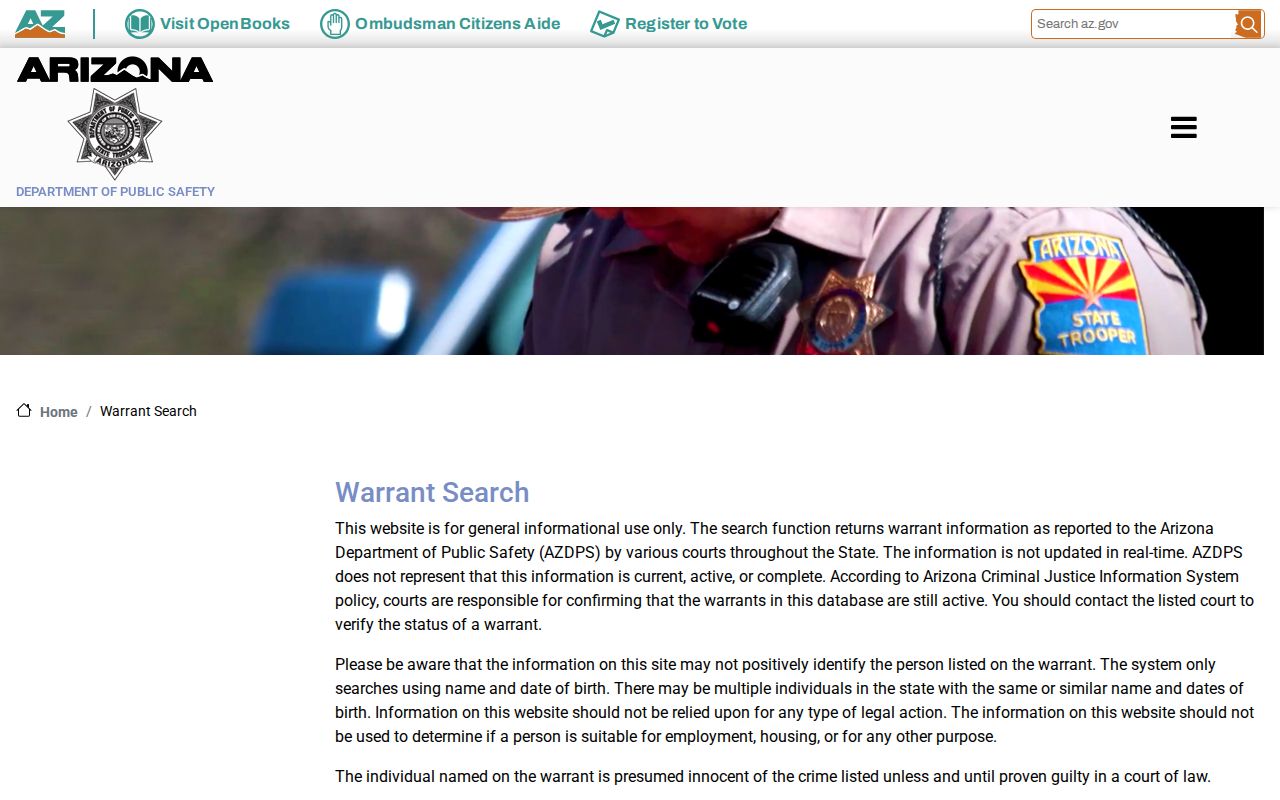
The official AZDPS Warrant Search reflects court-reported data rather than live arrests. It asks for first name, last name, and date of birth. It returns at most five results. The site itself warns that entries may be incomplete or outdated. Confirm any possible match with the issuing court.
The AZDPS Warrant Search screen displays the official query entry point. A result still calls for court verification and a careful identity check.
AZDPS also coordinates the Arizona Wanted Task Force. Coconino accepts warrant tips. Apache Citizen RIMS includes a warrants module. The state posts no single most-wanted gallery, and ADCRR’s fugitive and absconder programs are not county-booking lists.
The U.S. Marshals Service District of Arizona works all 15 counties and takes tips at 1-888-869-4589. Its Profiled Fugitives page shifts as cases change. An archived profile or press release is no live jail roster, and an old news story does not mean a person is still wanted.
After an Arizona Arrest
Four records can tell four different stories after an Arizona arrest: the county booking, the court case, VINE custody status, and state-prison status after sentencing. A booking charge can change before filing. Release does not close a case. VINE speaks to custody only.
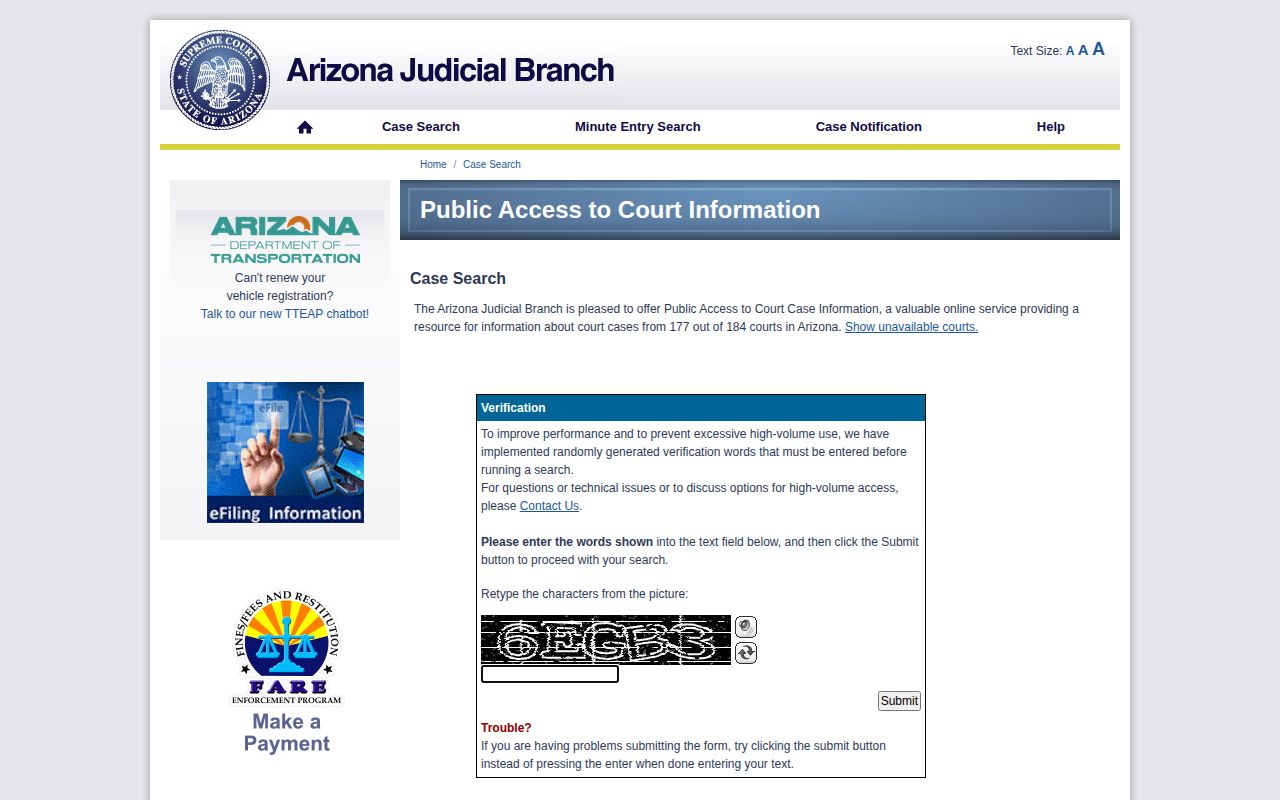
The Arizona Public Access Case Lookup covers most, but not all, courts and warns that data may be incomplete, outdated, or inaccurate. Superior Court eAccess has filing-date limits, different criminal coverage in Pima County, and sealed or sensitive records excluded. Some documents cost a fee. The Arizona courts’ neutral search page helps with case follow-up, though a case hit does not establish jail booking.
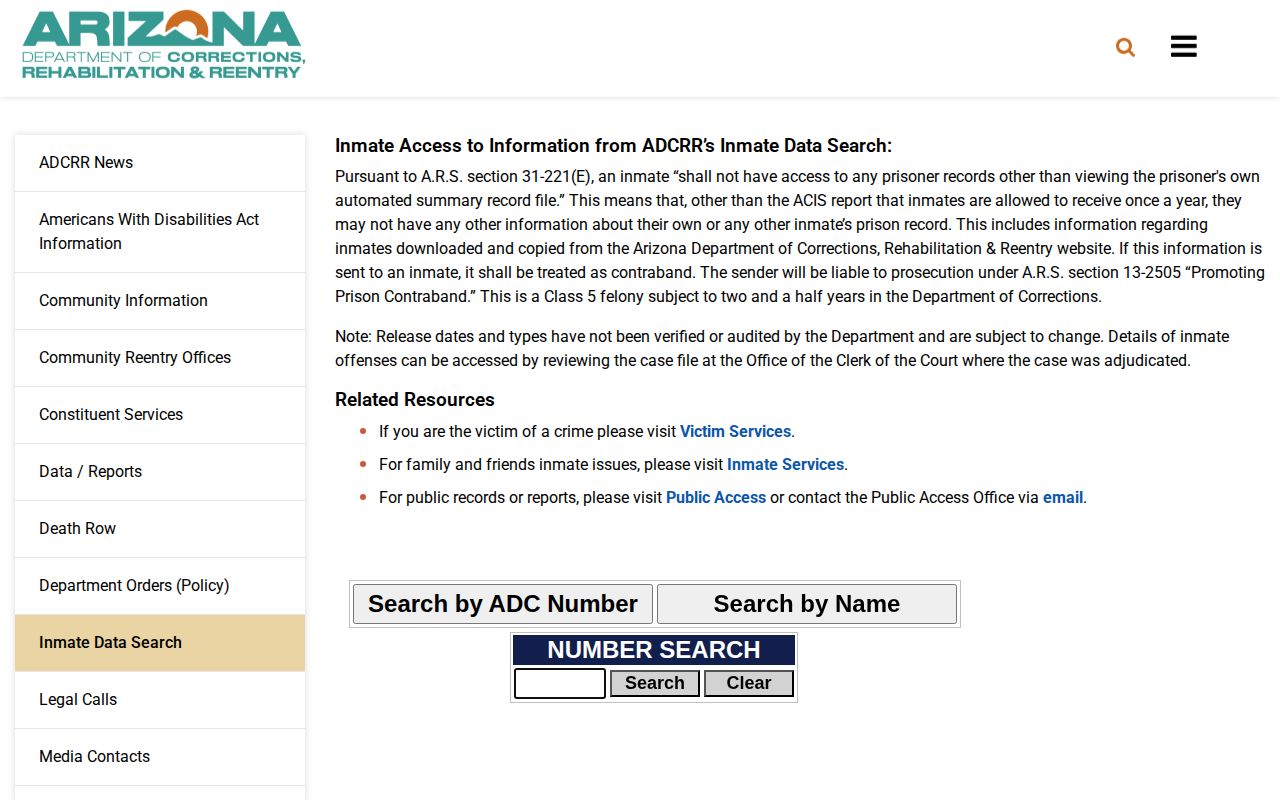
After sentencing, turn to the ADCRR Inmate Data Search. The ADCRR search page shows the official locator, whose state-corrections record and identification image differ from county booking material.
Federal custody runs on separate systems. The Bureau of Prisons locator covers federal inmates from 1982 forward but posts no public booking photos. ICE runs its own detainee locator for immigration custody. Someone missing from one system may be released, transferred, or held elsewhere, so a blank result settles nothing.
Request Arizona Arrest Records
A.R.S. § 39-121.01 requires public bodies to permit inspection. It also requires them to furnish copies promptly, within lawful limits and fees. Arizona has no single request form, cost, or turnaround for every county. City reports, jail bookings, court files, and trooper reports each sit with a different custodian. So ask the office that holds the record.
Name the event and record type clearly. That helps the office separate releasable fields from protected material. Juvenile, victim, witness, safety, investigative, or sealed information may be withheld or redacted. A requester can sometimes seek a withholding index. A denial is challenged through a statutory special-action process.
- Identify the arresting agency, county, approximate date, and likely booking custodian. For a trooper matter, start with the AZDPS Records Request page; for a county booking, use the sheriff or jail records unit.
- Name each requested item: booking sheet, booking number, arresting agency, booking and release dates, charges as booked, bond or release fields, incident report, and booking photo if maintained and releasable.
- Ask for an electronic copy or a redacted version if part of the record is restricted. Request the legal basis for any withholding and keep the receipt and response.
- Check fees and timing with that custodian before relying on a date. Keep the agency’s written answer, request number, and any record-series or destruction explanation.
AZDPS takes record requests three ways: its Records Request portal, in writing, or in person. Phone calls do not work. The fee schedule runs $9 for electronic requests up to 5 MB, $9 for the first nine paper pages, and $0.10 per extra page. Media, video, and photo charges sit on separate lines. Wait 30 business days before asking about status. Complex requests can run longer. Paying a collision-photo fee never guarantees a booking portrait exists. For county records, use the Directory or the county site, name the record type and approximate date, and the custodian may route your request or explain it does not hold that record.
Arizona Booking Record Retention
How long an Arizona booking record survives depends on the series it sits in. The state's 2026 general records schedule splits adult booking files into investigated and non-investigated series, and it treats juvenile records and other jail material separately. One adult series holds files ten years past last contact. A juvenile series runs to the person's eighteenth birthday. Filing category, legal holds, and custom schedules matter.
The Arizona State Archives keeps older government collections, including early Corrections material. Its catalog is incomplete. Most material must be viewed in person. For a current booking photo, the archives is not the first stop. Ask the agency that created the record about its series, last-contact date, destruction, or transfer to the archive.
Post-case relief usually means sealing under A.R.S. § 13-911. Nothing is erased automatically. Eligibility turns on the offense and statutory conditions. Sealing a government file leaves news and third-party copies untouched, so settle the official record first and then approach each publisher about its correction route. The Mugshot Website Operators Act, A.R.S. § 44-7902, targets commercial pay-to-remove solicitation. It is no statewide publication ban.
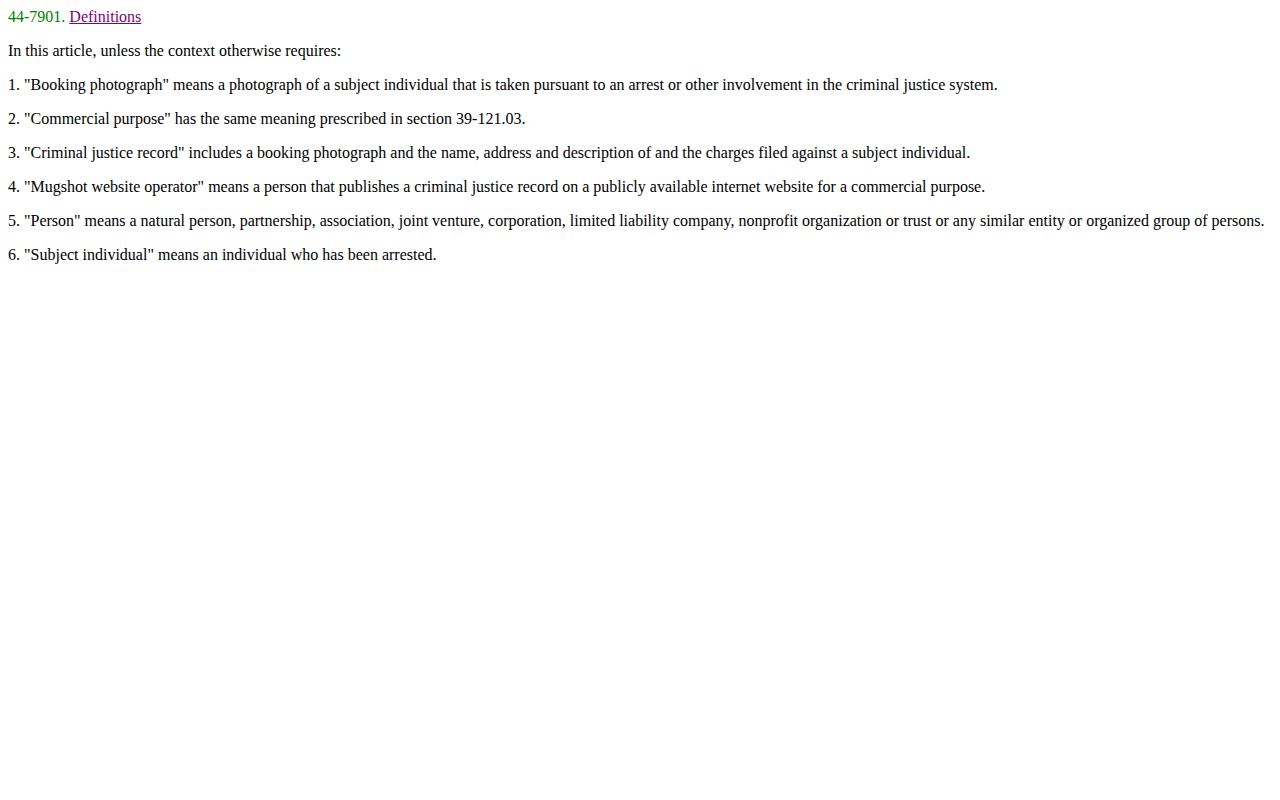
The A.R.S. § 44-7901 definitions separate a booking photo from the broader criminal-justice record the law covers. The statutory text is what the page displays.
Publisher correction routes vary widely. BustedNewspaper asks for the listing URL plus legal support for a dismissal or sealing, and its form quotes a five-to-ten-day review. RecentlyBooked reviews sealed, dismissed, wrong-person, outdated, juvenile, and duplicate entries at no fee, while generally keeping accurate current records. Mugshots.com posts free updates with qualifying documents, with review up to ten business days.
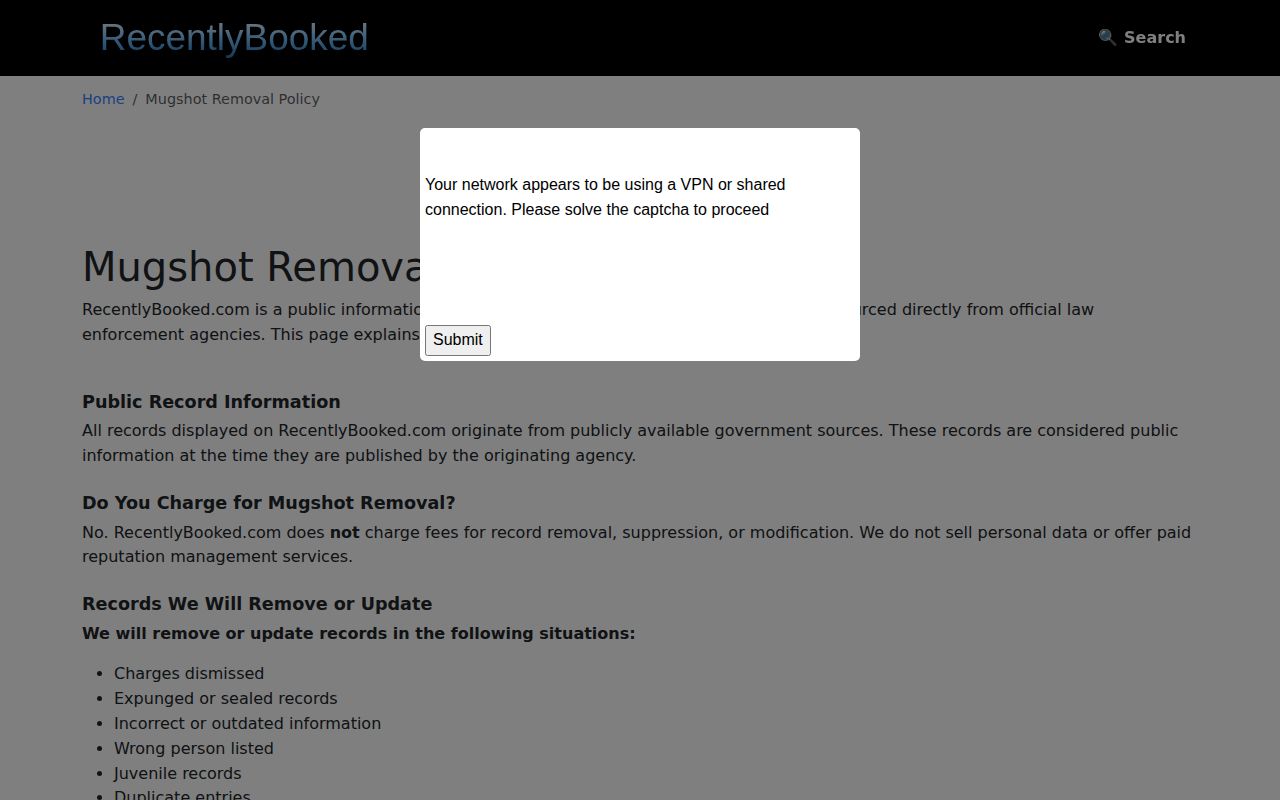
Arrests.org's Arizona page offers privacy controls. It states no clear free correction policy. Mugshots.zone's contact route wants a listing URL, a reason, and supporting documents, with conditional review that may run five to ten days. These are policies, not promises. The RecentlyBooked policy page sets out its correction criteria. Nothing there is an arrest record or a removal guarantee.
Never pay a service promising total erasure. Nothing does that. A court order, an agency correction, a publisher update, and a search-engine refresh each reach different places. Arizona's statute erases no lawful copy. The Public Arrest Records page details the law and sealing rules. Attach the official outcome when you ask a publisher to fix an entry.
Does sealing make every online copy disappear? No. A court order can close public access to covered government records, but publisher and search-engine copies may need separate requests, and an index can stay stale after the source changes. A missing roster entry can mean a limit, a release, a transfer, protection, an archive gap, or scheduled destruction. Ask the original custodian which applies.